

Walking into the aisle of any household perfume, you will find the selling points of the packaging: larger containers, thicker mist, and longer shelf life. Bringing this kind of logic into the office will backfire. The diffuser in the living room can flood the table, draw people's attention to making phone calls, or leave a damp film near the keyboard and documents. The problem with office odors does not lie in contact, but in restraint, silence and the social reality of sharing air.
This distinction will push workplace diffusers towards cold air, waterless and specific area designs in 2026. The global aromatherapy diffuser market is expected to grow at an annual rate of approximately 7% by 2033, with workplace health and "personalized sensory experiences" being regarded as the strongest demand drivers. But for those who choose a unit as their actual office, the practical question is narrower: Which diffuser is suitable to be placed on a desk, meeting room or floor without becoming something annoying? The following is the lineup for 2026.
Office Diffuser List: Four Things More Important than Fuel Tank Size
Noise, rather than coverage, is the first filter. In a quiet office, a diffuser of 35 decibels or higher will become a sound that colleagues notice. Models with a rated value of 30 dB or less mix in the background humming sound of HVAC. For anyone answering the phone at their desk, the target should be 25 decibels or lower. A professional space purchasing guide clearly states the threshold for an office: the target is below 30db. The noise of the quietest air conditioners and waterless devices nowadays is within the range of 23 to 25 decibels, quieter than a whisper.
Waterless cooled air diffusion is a safer desktop technology. The ultrasonic diffuser vibrates water into a cool mist, increasing humidity and leaving a thin layer of wet film on paper, monitors and keyboards throughout the working day. The anhydrous diffuser directly atomizes pure oil through cold air pressure - no overturning reservoirs, no weekly descaling, and no condensation near electronic devices. For desktop environments, this is an advantage of maintenance and security rather than a luxury.
Coverage rating is a rough classification rather than a metric. The square foot data declared by the manufacturer does not follow the shared industry testing standards. Ceiling height, furniture and closed doors can change the real-world results. A 700-square-foot area might be suitable for use as a small meeting room or a private office. Open floors require completely different types of equipment.
Control should be cautious and preferably based on a schedule. There must be a switch in the small compartment that can both turn off the lights and disperse the fog. In most offices, Bluetooth or app scheduling is more important than voice control: it enables odors to operate for a short period of time in the morning and after lunch, rather than running non-stop throughout the day.
Most suitable for personal desks: AM66
A desk is not a small room. It is an air bag against the wall, usually blocked by the monitor section, and is the place with the fewest available power sockets in the building. The device that best handles this geometric shape is not a room diffuser that lowers the volume, but a small cold air device, whose minimum setting is designed for a few feet rather than several hundred square feet.
AM66 is the most airflow-restricted space that no one can smell, and that's precisely why it works at the workstation. It uses cold air nano-mist, neither heating nor water. It uses rechargeable batteries, is powered through the USB-C interface, and offers three strength levels - the lowest is the strength level that the desk really needs. It contains 10 milliliters of essential oil, so it was not replenished immediately.
These restrictions deserve to be made clear: no Bluetooth, no app, no published area rating, and no schedule. It is a switching device. But for a desk, its goal is a brief and pleasant window of scent rather than a day's work, and this simplicity is the key.

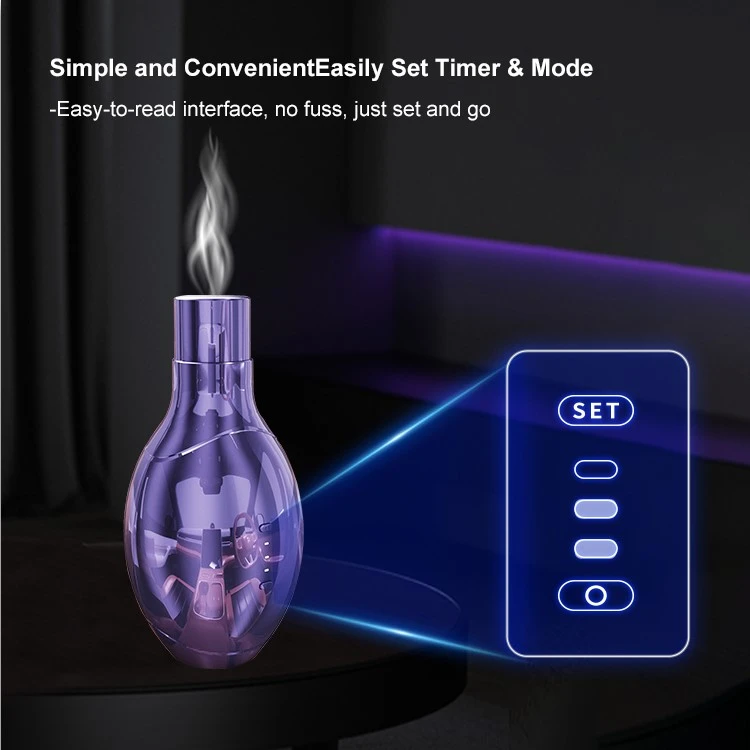
Most suitable for private offices or small meeting rooms: AM50pro
Once this space has a door - a private office, a phone booth, a small meeting room - a cordless device with a schedule becomes even more useful. The AM50PRO is powered by 6 A batteries, has an area of up to 300 square feet, and is equipped with a Bluetooth app to control intensity and timing. It is completely cordless, so it can be placed on a shelf or conference table without having to look for a socket. The cost of doing this is battery management: a spare A battery needs to be on hand.

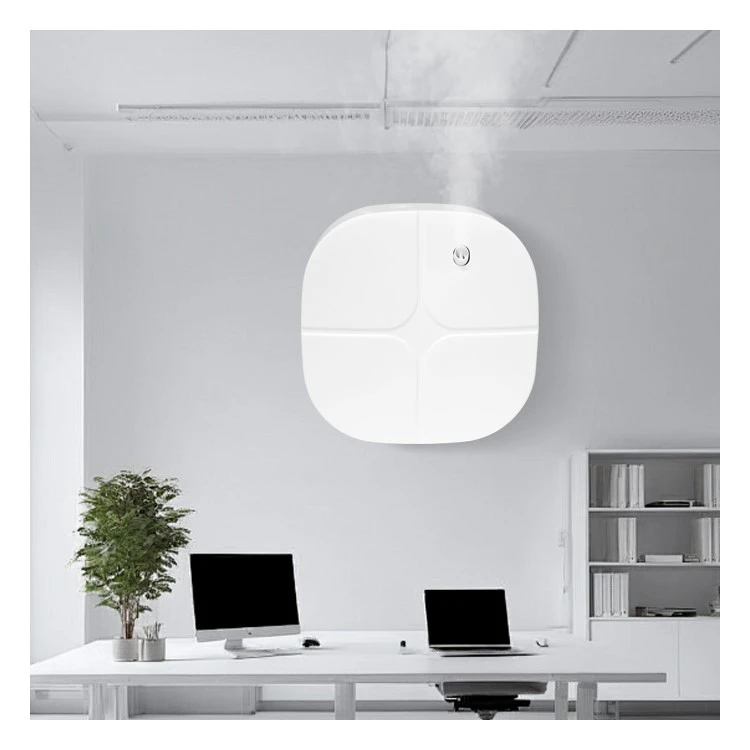
The best waterless alternative for portable desktops: F200B
For buyers seeking a waterless, battery-powered device without a proprietary oil ecosystem, the F200B has become a recurring choice in the 2026 office review. It comes with a 160-milliliter waterless reservoir, a battery that can run for 48 hours, and a rated space of up to 2,000 square feet. It is positioned as a portable wireless option for tables and small rooms, with no water tank to descale and no risk of condensation near electronic devices. The coverage statement should still be regarded as a category guideline rather than an exact measurement, but for personal workstations or small enclosed offices, it has different power supply and filling models.


Most suitable for open floors or commercial areas: HVAC integrated units or floor-standing cold air units
On a completely open floor, a personal diffuser is the wrong tool. The perception of space is a decision at the floor level, and the hardware will also change accordingly.
The LK3000 is directly connected to the existing HVAC system, covering an area of 30,000 square feet, and delivers fragrance to every corner of the area through a piping system, maintaining a consistent level. Installation requires connection to the HVAC system, which may need professionals. However, once installed, it will not add machine noise to the room and does not require multiple independent devices. For larger commercial Spaces, systems like the National Fragrance Center have a rated space of up to 750,000 cubic feet and are designed for multi-district office buildings.


In the absence of a piping system, a floor-standing cold air diffuser, such as the GE900, which covers an area of 6,000 square feet, includes a key lock for commercial environments and uses a 1000 oil tank, is a practical choice for large co-working floors or event Spaces.


Notes on scent selection and shared air
The scent of shared offices is first and foremost a social issue, and only then a technical one. Ask the people sitting nearby before arriving at the workplace, not after. If the answer is yes, then keep it light: the lowest setting, a short window of 20-30 minutes, rather than continuous output, and a clean fragrance series - tea, soft citrus, light musk - rather than sweet or heavy, as these scents last longer and split opinions more quickly. If colleagues say this bothers them, then turn it off. The nose can adapt in about 20 minutes, which is why people raise the temperature around 10 a.m. Anyone who has passed by has not adapted. A lower setting is a pleasant room rather than an air freshener.
The best office diffuser in 2026 is not one with the largest fuel tank or the highest output. It matches the area: low-output cold air units for desks, cordless timed units for private offices or meeting rooms, hvac integrated or floor-standing systems for open floors. Noise below 30 decibels, waterless operation near electronic devices, and control schemes that support short planning Windows are more important than the original coverage requirements. In the shared air, constraints are a characteristic.


